
Tough Conversations We Need To Have, September 2026, Barcelona
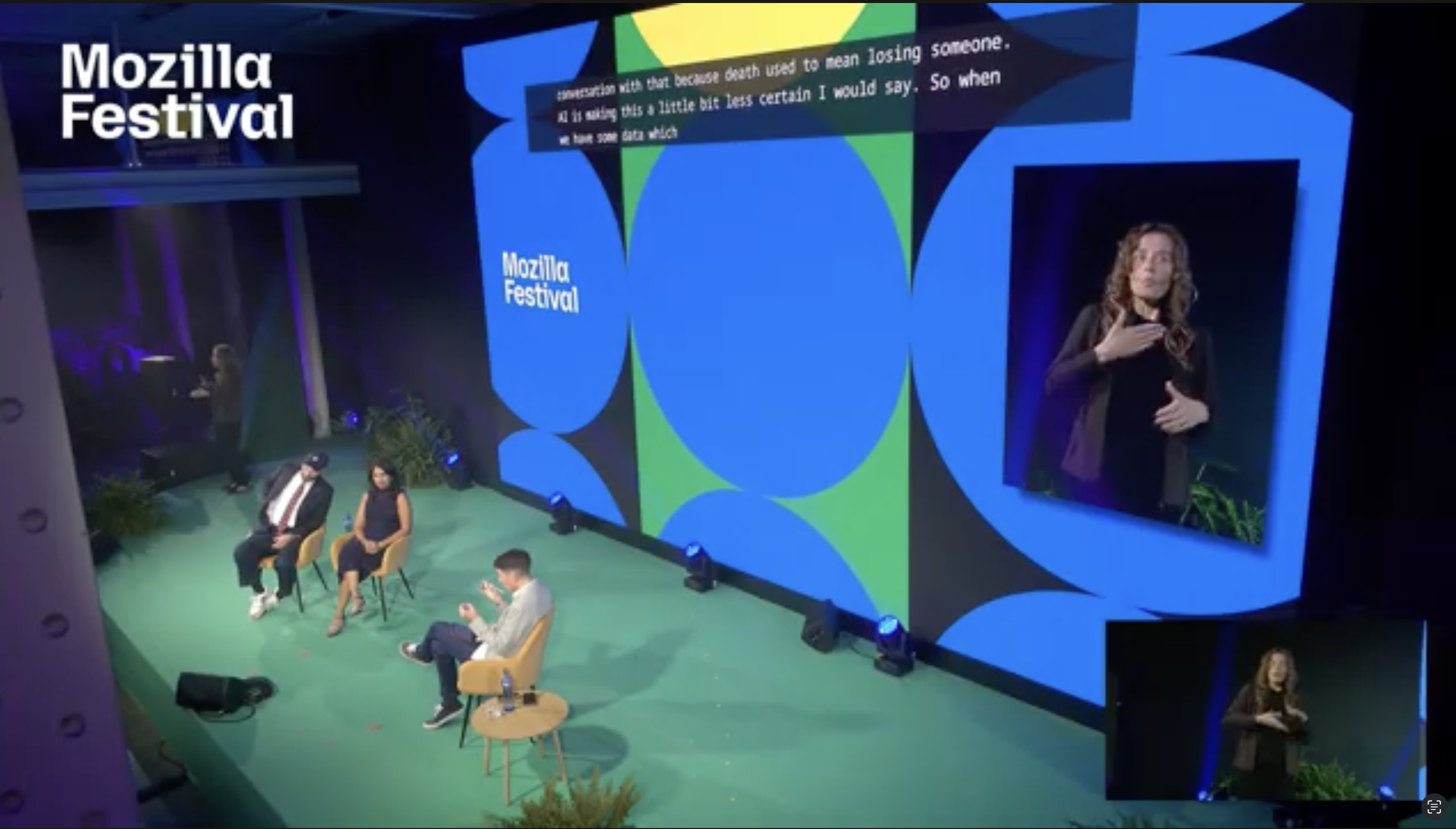
Watch the full session: Tough Conversations We Need To Have, Mozilla Festival. Moderated by AC Coppens, with Tahu Kukutai, Payal Arora, Abeba Birhane, Leslie Teo, Carl Öhman and Rupal Patel.
Six Voices, Three Conversations, One Stage in One Hour, Moderated by AC
In 60 minutes, six speakers joined AC on the Mozilla Festival Stage in Barcelona for three conversations about some of the most difficult questions at the intersection of technology, society and human rights. The format was an innovative, straight-to-the-point stream of conversations, without long introductions or warm-up, but with room for disagreement, uncomfortable questions and a few surprises.
Conversation 1: The Right to Exist, The Right to Disappear
Tahu Kukutai, Professor of Demography at the University of Waikato and Co-Director of Ngā Pae o te Māramatanga, and Payal Arora, Professor of Inclusive AI Cultures at Utrecht University and Co-Founder of FemLab, explored data sovereignty, collective privacy and the limits of individual consent.
Tahu reminded us that data is a taonga, a treasure whose stewardship is collective. Yet not one country in the world has a legal framework for collective privacy. As she put it, “individual privacy is fundamentally broken.”
Payal challenged the way we understand consent: it only means something when we have a real choice. Without it, consent is simply the terms and conditions we all click to exist online.
Conversation 2: Planted or Transplanted: Sovereignty Sold Separately
Abeba Birhane, founder of the AI Accountability Lab and Senior Research Fellow at Trinity College Dublin, and Leslie Teo, Senior Director of AI Products at AI Singapore, took on the question of who owns the knowledge and languages used to build AI, and who actually benefits.
Abeba dissected Meta’s “No Language Left Behind” initiative: more than 200 languages collected in the name of saving them, with nothing returned to the communities and subpar language technologies eventually sold back to them. Care or conquest? For her, the evidence was clear.
Leslie presented SEA-LION, built on open foundations to demystify what Silicon Valley and Hangzhou keep secret. “If it’s secret, you don’t have a choice. You have no sovereignty.”
Conversation 3: Who Gets to Speak for the Dead?
Carl Öhman, Associate Professor of Political Science at Uppsala University and author of The Afterlife of Data, and Rupal Patel, former CIA officer, entrepreneur and author of From CIA to CEO, turned to our digital afterlives. What happens to our data, identities and voices when we die? Who gets to decide what happens to them?
Carl pointed out that under the GDPR, data protection rights effectively disappear when we die. He proposed treating our “digital flesh” more like a corpse: something you don’t own and cannot sell. By the 2060s, Facebook could host more profiles of dead people than living ones.
Rupal brought the discussion closer to home: a few seconds of someone’s voice are now enough to recreate it. “We would never harvest an organ from someone who never consented to that, right? So why are we doing it with our digital remains?”
At the end, AC asked the audience who should speak for the dead. A few hands went up for big tech. An unexpected answer, and certainly a reason to continue the conversation.